
WineConX Blog
What Does Wine Influencer Marketing Cost in 2026?
By WineConX Team ·
“What will it cost?” is the first question every winery asks about influencer marketing, and the honest answer is “less than you fear, more than the post fee.” This guide breaks down real 2026 price ranges, the costs nobody mentions, and what sensible campaigns look like at three budget levels.
Typical rates by creator size
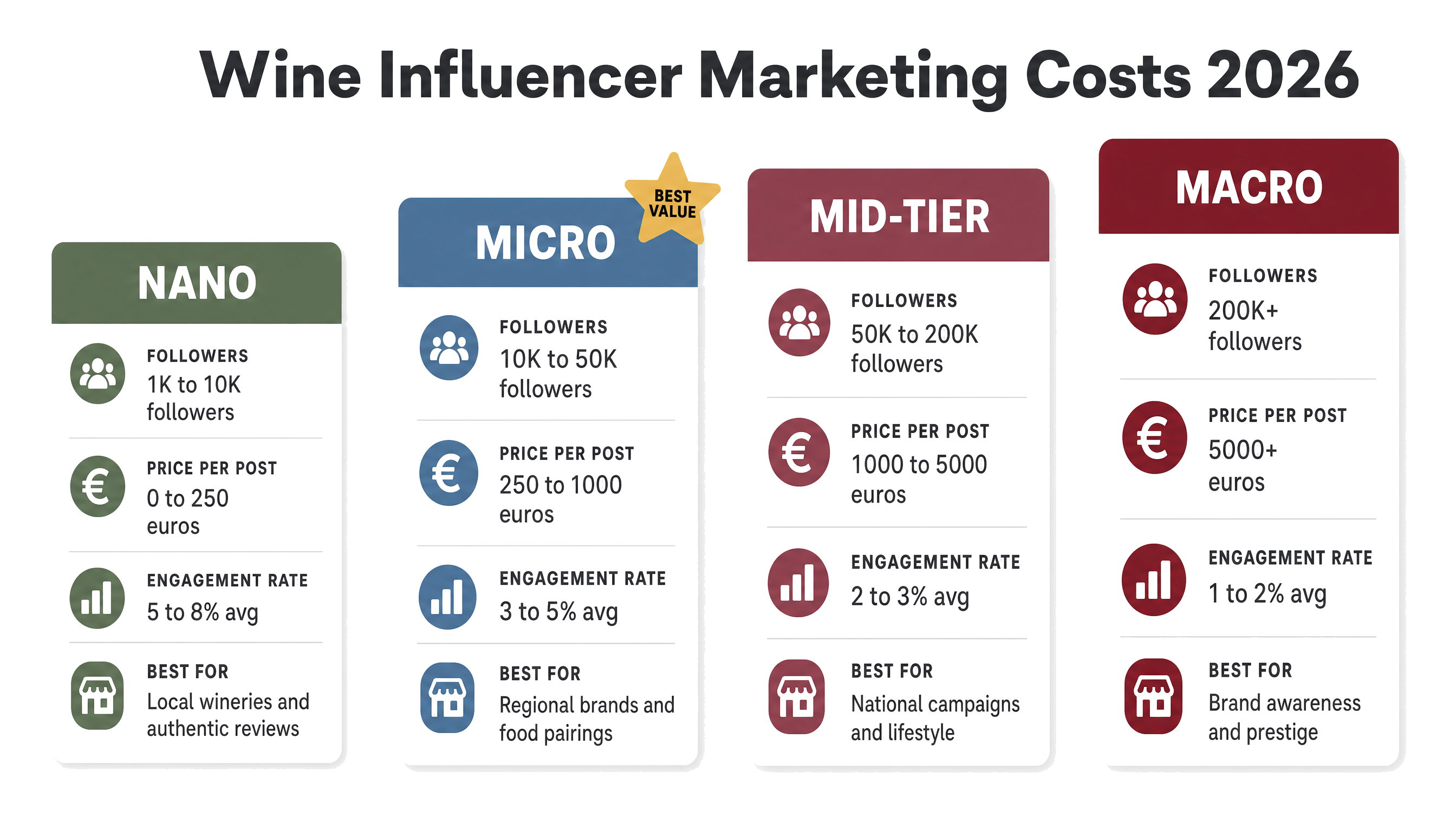
Creator fees scale with audience size, engagement and professionalism. For the wine and food niche, expect roughly (rates are consistent with data from the Influencer Marketing Hub Benchmark Report and Kolsquare’s creator pricing studies):
- Nano (1k–10k followers): free product to ~$250 per post. Enthusiasts, often thrilled to work with a real winery.
- Micro (10k–50k): $250–$1,000 per static post; $400–$1,500 for a Reel. The workhorse tier for wine brands.
- Mid-tier (50k–250k): $1,000–$5,000 per deliverable, usually packaged (post + stories + Reel).
- Macro (250k+): $5,000–$20,000+, agency-negotiated, booked weeks ahead.
Format multipliers apply everywhere.
Video costs 1.5–3x more than a static post, a story sequence adds 20–40%, and usage rights for your own ads typically add 25–50% to the fee — consistent with data from the Influencer Marketing Hub.
Exclusivity (the creator won’t promote competing wineries for a period) costs extra and is usually worth it.
Two negotiation notes worth money: first, packages beat single posts. A bundle of one Reel, one feed post and three stories usually costs 30–40% less than the items priced separately, and performs better because the audience sees the wine repeatedly. Second, long-term beats one-off: three collaborations over six months typically cost less per post than three separate bookings, and repeated genuine endorsement is what actually moves purchase decisions in wine.
Product-only vs paid collabs
Wine has an advantage most industries lack: the product is desirable, giftable and photogenic. Genuine product-only collaborations are realistic with nano and small micro creators. A case of wine plus shipping in exchange for a post is a fair trade at that level, and the content is often charmingly authentic.
But be realistic about the ceiling. Established creators pay rent with brand fees; offering only bottles to a 40k-follower wine account reads as disrespect and burns the relationship. A good rule: product-only below ~10k followers, product-plus-fee from 10k up, and always send the wine regardless. A creator who has not tasted your wine cannot recommend it credibly.
Hidden costs (briefing, management)
The post fee is the visible half of the budget. The invisible half:
- Research and vetting: 10–20 hours per campaign if done manually, finding candidates, checking audience quality, filtering out bought followers.
- Outreach and negotiation: expect to contact three creators for every one who says yes at a workable rate; each needs follow-ups and terms.
- Briefing and coordination: writing the brief, shipping bottles, approving drafts, chasing posting dates. Per creator, count 2–4 hours.
- Product and shipping: bottles, packaging, and cross-border alcohol shipping paperwork where applicable.
- Compliance review: alcohol advertising rules and ad-disclosure requirements differ by country; someone has to check each post.
- Measurement: collecting screenshots and insights from every creator and turning them into a report your team can act on.
For a five-creator micro campaign, this overhead is easily 30–50 hours. Price your own time honestly, or a manager’s, before comparing DIY to an agency or platform fee.
Sample campaign budgets
Starter (~$500–$1,000). Two or three nano/small-micro creators, product-plus-small-fee, one post and stories each. Goal: first proof that influencer content moves followers and tasting-room visits. Realistic outcome: a few hundred new relevant followers, content you can repost.
Growth (~$2,500–$5,000). Five to eight matched micro creators in one coordinated window, mixed posts and Reels, usage rights on the best two assets. Goal: measurable follower growth and traffic to your shop or club. This is the budget where wine campaigns start compounding.
Launch (~$8,000–$15,000). One mid-tier anchor plus eight to twelve micro creators, video-heavy, staggered over six weeks, full usage rights. Goal: new-market entry or flagship release. At this level professional management is no longer optional overhead. It is most of the difference between reach and results.
How to start small
The cheapest useful campaign is not the cheapest possible campaign. Start with a clear single goal (followers, visits, or shop clicks; pick one), three well-matched micro creators rather than ten random ones, and a four-week window. Measure everything, keep what worked, and reinvest. Influencer marketing in wine rewards iteration, not one-off splashes.
If you would rather skip the spreadsheet hours entirely, our Influencer Marketing service builds the shortlist by follower-quality analysis, handles outreach and briefs, and reports the results. Request a quote and we will design a campaign around your budget.